


There’s a specific face people make when the conversation gets too close to their mother.
It’s not anger. It’s not grief. It’s this quick, almost imperceptible tightening — like they’re about to say something honest and then thought better of it.
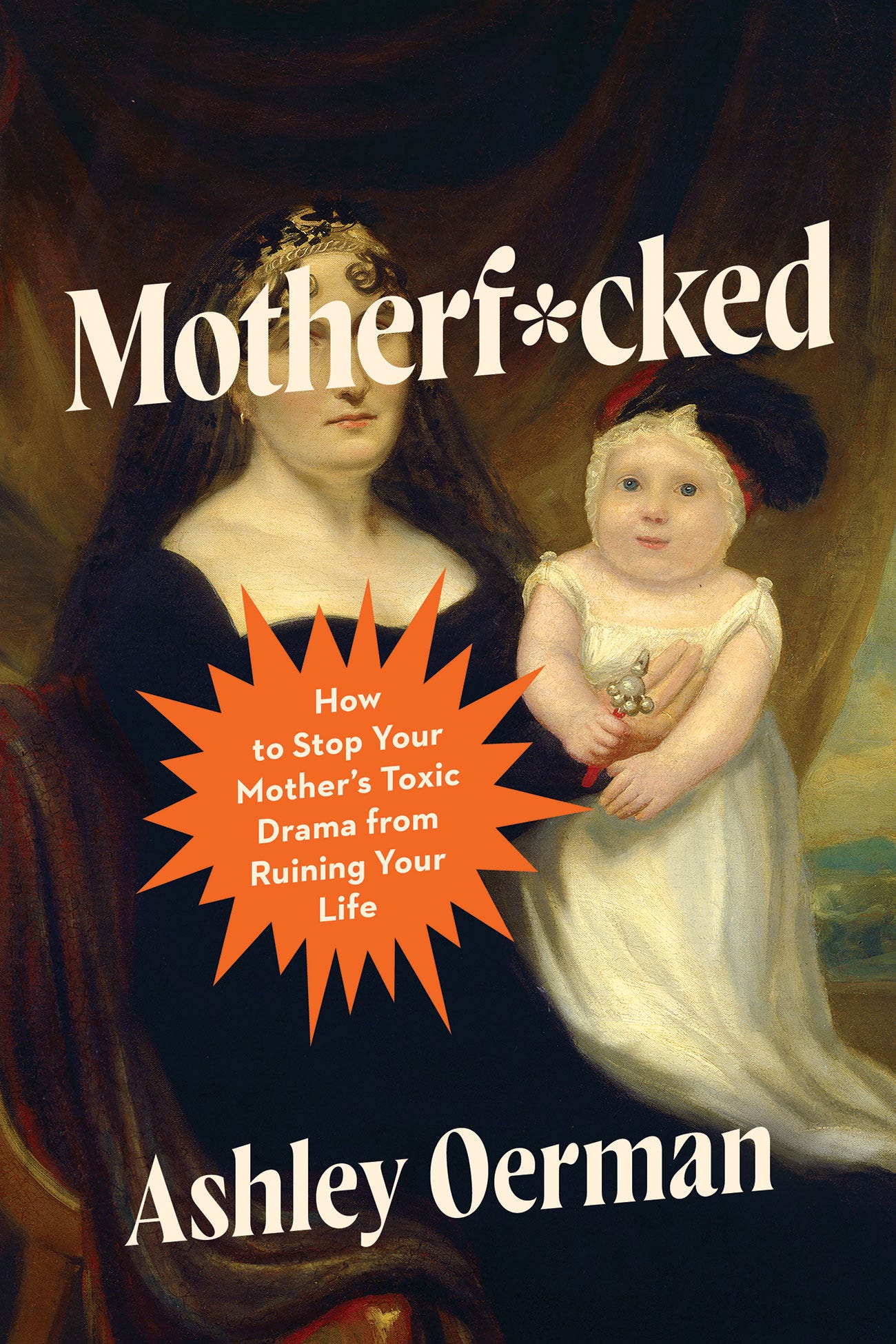
I’ve seen it in my office hundreds of times. And I saw a version of it in myself when I sat down to talk with Ashley Orman, author of Motherfucked: How to Stop Your Mother’s Toxic Trauma from Ruining Your Life.
Within five minutes we were already somewhere most people spend decades carefully walking around.
Here’s the thing about mother wounds that makes them so hard to work with:
They don’t look like wounds.
They look like personality.
They look like “I’ve always been someone who needs a lot of reassurance” or “I just have a hard time with conflict” or “I don’t know why I feel so guilty when I say no to people.” They look like patterns you’ve accepted as you — fixed, permanent, just the way you’re wired.
Ashley’s entry point into all of this wasn’t a therapy office. It was a pitch meeting at Cosmopolitan Magazine — her dream job — where she suddenly couldn’t read the words on the page or breathe.
Full panic mode.
She started therapy to address what looked like social anxiety, and a few sessions in, her therapist asked a pretty simple question: Why do you worry so much about whether your coworkers think you’re weird?
Ashley’s first reaction was basically, …because who wants to be weird?
But the real answer, the one that took longer to get to, was this:
I don’t want my coworkers to see me the way I see my mom in social situations.
That’s the moment she describes as both a relief and a gut punch. On one hand — clarity.
On the other: Oh great, I’m a cliché. My issues trace back to my mom. Fantastic.
That’s exactly how it works, though. Most relational interactions from early family dynamics doesn’t announce itself.
It integrates. It becomes the operating system running quietly in the background while you’re busy trying to figure out why your marriage feels like work, why you snap at your kids in ways that scare you a little, why you can’t seem to hold a boundary without feeling like a terrible person for three days afterward.
One of the things I pushed back on — gently — during our conversation is the way people tend to think about this stuff in binary terms.
Either your mom was great, or she beat the shit out of you and didn’t feed you.
That’s not how it works. That’s almost never how it works.
Ashley discovered the “healthy relationship spectrum” in her research — a framework mostly used for romantic relationships that applies just as well to the parent-child dynamic. And the key insight is that there’s a massive gray zone between “healthy” and “abusive,” and that gray zone has a name: unhealthy.
You can be a little bit unhealthy, or a lot unhealthy, or borderline — and it doesn’t matter exactly where you fall on that spectrum, because if you’re in the unhealthy zone, there are things you can do.
You’re not disqualified from working on it because your mom didn’t technically meet the diagnostic criteria for monster.
I see this all the time in my practice.
Clients who come in and preemptively apologize for their own therapy: I know it sounds like I’m just bashing my parents. Or the flip side — clients who resist doing this work because they’re convinced therapy is just an exercise in blaming mom and dad for everything.
Parents even accuse me and the entire profession on this! I talk about being able to explain, explore, and help people evolve, instead of blame, shame, and guilt.
What it actually looks like is learning to hold multiple truths at the same time. Your mom is a person who did her best and her best caused real harm, even though it may be unintentional.
You love her and the relationship isn’t working for you.
Empathy and accountability aren’t opposites.
That ability to hold complexity — what is called dialectical thinking — is genuinely a lost art right now, and it’s one of the things that makes this work so hard for people to even start.
Ashley made a point that I want to sit with for a second, because it’s one that doesn’t get said clearly enough:
We are basically born to be our mom’s biggest fan.
That’s not poetry. That’s attachment theory. From the moment you arrive, she is your life support. Your nervous system literally co-regulates with hers. When she’s calm, you learn calm is possible. When she’s consistent, you learn that people can be counted on. The goal, in a healthy developmental arc, is that you slowly need less of that external regulation and build the capacity to do it yourself.
But here’s what happens when that co-regulation breaks down — when a parent can’t or won’t do it consistently: the child doesn’t just lose out on soothing. They adapt.
Some become pleasers. They learn to actively manage the parent’s emotional state because a regulated parent is a safer parent. Some become what I’d call acquiescers — which looks similar from the outside but is different.
They don’t do things to make you happy; they just suppress what they want and go with the flow. No protest, no pushback, just a slow erosion of their own preferences and needs.
Both are adaptations to the same problem: an unpredictable emotional environment they were too small to do anything about.
And then there’s a third pattern I see that surprises people when I describe it. Some kids learn to actually manufacture chaos. They sense the parent is about to blow, and rather than wait for the inevitable, they engineer it — act out, push buttons, create the explosion — because at least that way it’s over and they can relax.
It sounds counterintuitive. It’s actually completely logical. Once you’ve mapped a pattern, you play into it.
The reaction is older than the situation. That’s true for adults in therapy. It was also true for you as a kid doing the only thing you could with the information you had.
Here’s where I think a lot of “healing” content gets stuck:
It treats awareness as the destination.
Name the wound. Trace it back. Nod somberly at your inner child. Post about it. And then nothing changes.
You’re just a more articulate version of stuck — which can actually be its own trap, because now you sound like you’re doing the work.
What moves the needle is repatterning. That means learning to tolerate guilt when you set a limit with someone you love. It means letting people be disappointed without treating their disappointment as a verdict on your character. It means separating love from obligation — which, if you grew up in a family where those two things got fused together early, is genuinely some of the hardest work a person can do.
Ashley’s framework for boundaries is one I’d actually assign as homework: treat it like an experiment. Set the boundary. Watch how the other person responds. Take in the data. If you get pushback — and you usually will, because boundaries are rarely met with oh, that’s completely reasonable — that information tells you something.
It might tell you the boundary needs to be firmer. It might tell you the relationship requires more distance than you’d hoped.
You keep running experiments until you find an equilibrium where you can exist in the relationship without it colonizing your brain when you’re not in it.
Ashley put it plainly: it sucks, and it’s not easy. I’d add: the covert guilt and shame are usually worse than the overt conflict. At least with overt conflict you know what you’re dealing with.
The passive-aggressive slow drip — the martyrdom, the sighing, the I just want you to be happy delivered with a look that says the opposite — that’s the stuff that really gets in people’s heads.
There’s a dynamic I brought up in our conversation that I want to name here, because I think it explains a lot of why this wound stays invisible for so long.
We tend to figure out whether our family relationships are healthy by comparison. We look at our friends and their moms. We see what other people seem to have. But here’s the problem: we only ever see the surface.
I do family therapy, and I can tell you that some of the most outwardly warm, close-looking mother-child relationships I’ve worked with have almost no real emotional intimacy underneath. No genuine vulnerability. Limited open emotional curiosity.
Just performance — judgment, covert shame, enmeshment — all dressed up in the costumes of closeness. This may have been what was modelled for them and they experienced as well seemingly why they struggle sometimes to see their own behavior. They needed to rationalize their own upbringing with their parent.
Ashley told a story about her sorority’s Mom’s Weekend in college. Her friends’ moms got hotel rooms, went shopping, got emotional at the goodbye brunch on Sunday. Her mom showed up late, slept in Ashley’s dorm room, and left early. And Ashley walked away from that weekend feeling like she was the weird one, the dysfunctional one — like she was the problem in the picture.
That’s what comparison does. It takes a data set of performance and asks you to measure yourself against it.
She also mentioned something that hit me: attachment research suggests most young adults — up through older age — consider their mom one of their closest relationships. But as anyone who’s been in a painful romantic relationship knows, your closest relationship is not always your healthiest one. We can be deeply enmeshed in something that isn’t working and still call it close. Still call it love.
Families are kind of like cults in that way. There’s a lot of outward devotion and ritual and loyalty, and underneath, sometimes, there’s a tension that doesn’t make sense if you’re only seeing it from the outside.
I want to be clear about something, because Ashley was clear about it and I think it matters:
This book is not a takedown of mothers.
READ IT AGAIN IF YOU HAVE TO!
Ashley intends to be a mom herself. The goal isn’t to blow up the relationship or hand people a permission slip to cut contact because TikTok told them to. The goal is something harder and more useful — seeing your mom as a real person, with her own wounds and limitations and history, and acknowledging that a real person’s behavior still causes real harm, and deciding what you want to do with that information.
Empathy for your mom and accountability for what the relationship cost you are not mutually exclusive. You can hold both. And empathy for yourself — which gets completely lost for people in the gray zone, the ones who say things like I was fed, she took me to soccer — that’s not optional. That’s the work.
You may never fully understand why your mom is the way she is. Ashley made peace with that. The mysteries don’t have to be solved for you to decide how you want to live in the relationship going forward.
If any of this landed somewhere uncomfortable — not quite recognition, not quite denial, somewhere in that in-between — Ashley’s book is worth your time.
She wrote the book she needed fifteen years ago. It’s grounded in interviews with licensed therapists, grief researchers, and attachment theorists, and it reads like a person, not a textbook.
You can find it anywhere books are sold, or grab it on Amazon here!
And if you want to sample Ashley’s voice before you commit, her Substack — Motherfucked, the Emotional Support Newsletter is worth subscribing to. She’s also on Instagram if that’s more your speed. The book drops April 28th.
Looking super forward to reading this