


Or: how to win an argument about something that isn’t even happening — and how to do it simultaneously with someone who is doing the exact same thing to you
Let me introduce you to foie gras.
Not because I’m about to give you a recipe — I am a therapist, not a chef — but because the way foie gras is made is one of the most accidentally perfect metaphors for a relationship dynamic I’ve been watching unfold in my office for years and recently finally found a name for.
This one is for you Rob and Barb!
Foie gras is created through a process called gavage.
A tube is inserted down a duck or goose’s throat and grain is forced directly in. The bird doesn’t get a say.
It can’t pace itself, can’t decide it’s had enough, can’t negotiate.
The liver swells under the pressure of something it never asked to receive. The result is considered a luxury item at fancy restaurants.
The process is considered, by a growing number of people, a cruelty.
I’ve been thinking about this image — a lot — in relation to how we sometimes talk to the people we love most.
I’ve started calling it Goosenecking.
What goosenecking actually is…
Goosenecking is when one person enters a conversation — a disagreement, a check-in, a “hey can we talk” — already holding a fully formed conclusion about what the other person is doing, feeling, or why. Not a question. Not a hunch. A verdict. Delivered before the other person has finished their first sentence. Sometimes before they’ve started.
It sounds like this:
“You’re doing that thing again where you shut down when you feel cornered.” “You only brought this up now because you’re trying to avoid the real issue.” “I know you. This is exactly what you always do.”
And just like that — tube inserted, narrative delivered — the other person is no longer in a conversation. They’re in a deposition. GOTCHA!
Goosenecking is essentially telling the other person you could not care less about how they actually feel, and that you really wish they’d stop insisting that what you just described isn’t what’s happening.
When actually?
It’s not at all what’s happening.
(And yet somehow pointing that out only seems to make things worse. Funny, not funny how that works.)
I wrote about this exact breakdown in The 5 Ways Communication Breaks Down When Emotional Trust Is Missing — specifically the moment when expression stops being about your own inner experience and becomes a verdict on someone else’s character. I called it labeling.
Goosenecking is labeling with momentum. It’s a label that arrives with a whole courtroom attached to it.
Guilty before the defense rests. Or even begins.
Here’s what makes goosenecking so maddening to be on the receiving end of: the other person is now starting from a deficit. They didn’t come into this conversation to defend themselves. They came to share something — a feeling, an experience, a perspective — and now, before they’ve gotten a word in edgewise, they have a label to disprove.
So instead of saying what they actually came to say, they spend the next twenty minutes trying to convince someone that they are not the person currently being described to them. Which, by the way, is an exhausting thing to have to do about yourself.
The opposite can also be true where the person talking with their partner about their feelings is mischaracterizing or labeling their emotions, intentions, and goal…
“I’m not doing that.” “That’s not why.” “You’re not hearing me.” “That’s not what I meant.” — A highlight reel of conversations that were supposed to go very differently.
And here is the part that is genuinely cruel — not intentionally cruel, but cruel in effect: the harder someone fights to correct a false narrative, the more their desperation reads as proof of it. The urgency looks like guilt. The frustration looks like defensiveness. The whole thing collapses in on itself like a very expensive soufflé, and nobody gets the thing they actually came for.
The Trap, Illustrated: Person A assigns a motive. Person B denies it passionately. Person A takes the passion as confirmation. Person B gets louder. Person A feels more certain. Both people are now in completely different arguments — and neither one is the argument that actually needed to happen.
Now — because it would be irresponsible of me not to say this — it goes both ways
I want to be very clear about something, because if I don’t say it explicitly someone is going to read this entire article, nod vigorously, forward it to their partner, and completely miss the point.
This also would violate the marriage and family therapist in me!
Goosenecking is not something that only happens to you. It is also something you do. And in the most spectacular — and by spectacular I mean genuinely difficult to watch — cases, both people are doing it at the exact same time.
Think about that for a second.
Two people.
Each holding a tube.
Each absolutely convinced they are the one being force-fed a false narrative.
Each trying to express their real experience.
Each accidentally burying the other person’s real experience in the process.
Both feeling unheard.
Both feeling wrongly characterized.
Both getting louder or more withdrawn trying to fix it.
This is not a communication breakdown. This is a communication explosion. And it happens constantly, in kitchens and living rooms and parked cars and text threads, between people who genuinely love each other and have no idea this is what’s occurring.
What mutual goosenecking actually sounds like:
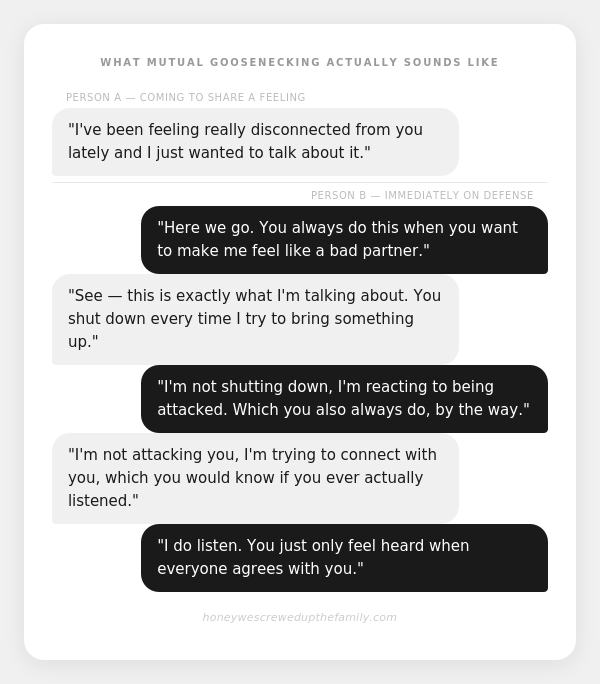
Nobody in that exchange is talking about disconnection anymore.
Nobody is even in the same conversation they started in.
Both people arrived wanting something real, and both people are now narrating the other person’s psychology at full volume while the actual feeling — the one that started this whole thing — sits in the corner completely unaddressed, waiting.
(It usually waits a while.)
This is what makes mutual goosenecking so particularly exhausting: both people feel like the victim of it, because in a very real sense, both people are. Person A goosenecked Person B’s reaction before it happened. Person B goosenecked Person A’s intention before they’d finished a sentence.
Now they’re both trapped in a story the other person wrote about them, furiously trying to rewrite it, while simultaneously authoring one right back.
It is, and I mean this with great clinical precision, a complete clusterfuck.
Here’s the part where I refuse to let either of you off the hook
Almost nobody who goosenecks knows they’re doing it. Because from the inside, it doesn’t feel like force-feeding someone a false story. It feels like finally being honest. It feels like bravely naming a pattern you’ve been too scared to address. It feels like insight.
The person doing it is usually in genuine pain. They have history here. The label they’ve applied isn’t random — it’s connected to something real, something that hurt.
Maybe from their upbringing, maybe from a past conflict with the other person, maybe its an insecurity being misplaced…
But in their effort to finally say the thing, they’ve made one critical, relationship-altering mistake: instead of naming their own feeling, they’ve named their partner’s motive.
Those are not the same thing. Not even a little.
“I feel invisible right now” is a door. “You make yourself invisible on purpose” is a wall. Same room. Completely different outcomes.
And this goes for the person on the receiving end too. Because if your first move when someone brings you a feeling is to diagnose their agenda — to decide before they’ve finished that this is an attack, that this is manipulation, that this is the same thing they always do — you’ve just picked up your own tube.
Congratulations. You’re goosenecking back. Nobody wins. Everyone goes to bed annoyed.
What’s needed here — from both people, in both directions — is what I’ve talked about before as open emotional curiosity.
Not a gotcha question wearing a question mark.
Not a tone that’s already decided the answer.
Actual curiosity.
The kind that approaches your partner’s experience like you genuinely don’t know what’s in there yet — because you don’t. A posture that says I want to understand this instead of I already do.
📄 The 5 Ways Communication Breaks Down When Emotional Trust Is Missing Covers the exact moment expression becomes labeling — and what open emotional curiosity actually looks like in practice. A direct companion to what you just read.
How it escalates (and it always escalates)
Once mutual goosenecking takes hold of a conversation, the original topic quietly exits the building. Now the whole conflict is about whose version of events is correct. Who is the reliable narrator of this relationship. And then — because nothing in an escalating conflict stays tidy — the past shows up uninvited.
Old arguments, unresolved moments, that one thing from three years ago that was supposedly handled but apparently was not, make their entrance.
Not because they’re relevant, but because they’re evidence. The case is being built. On both sides.
Simultaneously.
One person shuts down. Not because they don’t care — because they’ve done the math and realized that no amount of explaining is going to move the needle tonight. The other gets louder, reading that shutdown as confirmation of exactly what they said in the first place.
Two people. Both trying to be understood. Both further from it than when they walked in.
“The tools they reached for to get closer to each other are the exact things building the wall between them. And both of them are holding a hammer.”
This is also where the benefit of the doubt goes to die. Once you’re both in full gooseneck mode, assuming good intent feels almost impossible — because the pattern you’re living inside feels like all the proof you need.
I broke down exactly why that assumption is still worth making, even when it’s hard, in my piece on the 4 I’s framework. Because if you can’t get back to “they’re hurting too, not just trying to ruin my evening” — you’re not going to find your way out of this loop. You’re just going to rotate through it every few weeks until one of you stops trying.
📄 Why Your Arguments Never Get Resolved (And What Healthy Couples Do Instead) The 4 I’s framework — including benefit of the doubt and commiseration — gives you an actual map out of the cycle that goosenecking creates. Start here when you’re ready to stop just surviving the fight.
The one question that changes everything
I’m not going to wrap this up with five easy steps and a breathing exercise. You’re welcome, and also I think we’ve all earned better than that.
What I will offer is one question — the one I keep coming back to, in my work and increasingly in my own life — that has a way of stopping goosenecking in its tracks before the tube even gets near the throat:
Am I describing my own feeling, or am I describing someone else’s motive?
That’s it. That’s the whole thing. And it applies whether you’re the one coming with something to share, or the one receiving it. Stay on your side of the line. Own your experience without narrating theirs. Say what you feel without diagnosing what they intended.
Not “you only do this when you want to avoid something” — but “I feel like I’m losing you right now and it scares me.”
Not “you’re being defensive” — but “I don’t feel heard and I’m not sure how to get through.”
One of those sentences invites a person in. The other puts them on trial.
And the beautiful, annoying, completely unglamorous truth is that you get to choose — every single time — which conversation you’re actually having.
And if you want somewhere to land after you’ve stopped goosenecking each other? Try commiseration. Not as a strategy. Not as a technique. Just — “this is hard for both of us, huh?”
Sit in it together for a second. That shared moment of damn, this sucks and neither of us wanted to be here is sometimes the only thing that actually breaks the gridlock.
I wrote about why that’s criminally underrated too.
The goose doesn’t get a choice. The tube goes in regardless.
You do. Both of you do.
And the moment both people put down the narrative they carried into the room — the verdict, the label, the I already know what this is and who you are when you do it — is the moment an actual conversation becomes possible.
Where two people who love each other, or used to, or are genuinely trying to, can finally just say the real thing.
Which, it turns out, is all either of them wanted in the first place.
(It’s almost always simpler than where it ended up. That part never stops being both tragic and a little bit funny.)
If this resonated, keep going:
📄 The 5 Ways Communication Breaks Down When Emotional Trust Is Missing — on emotional curiosity & labeling
📄 Why Your Arguments Never Get Resolved (And What Healthy Couples Do Instead) — on benefit of the doubt & commiseration
If this hit close to home — for better or worse, and probably both — share it with someone who needs it. And if you want more of this in your inbox, subscribe below. I promise to keep it honest, keep it useful, and keep it at least occasionally funnier than it has any right to be given the subject matter.
I call it being blown out of your body. It is a "lambasting". It is a toxic narcissists style of delivery. A false foundation and the arguments flow so fast you may as well walk out the door or hang up the phone. That is verbal abuse. I can't imagine standing for that sort of contact more than once. Self preservation requires one to disconnect.